
How many calls a week is enough to justify conversational insights?
September 24th, 2026
5 min read
By Will Maddox

Conversational insights gets marketed to contact centers, so smaller operations assume the answer is no before they run the numbers. Usually it is a ratio question rather than a volume question, and the ratio is often better at 200 calls a week than at 2,000.
This comes up on almost every first call. Someone has decided they want to know what is happening on their phones, then looked at a category built around the language of contact centers and concluded they are too small for it.
It is a fair worry, and sometimes the honest answer really is no. But the reasoning that gets people there is usually wrong, so here is the arithmetic laid out properly.
Your call count is not your conversation count
Start here, because every estimate built on the wrong number goes wrong in the same direction.
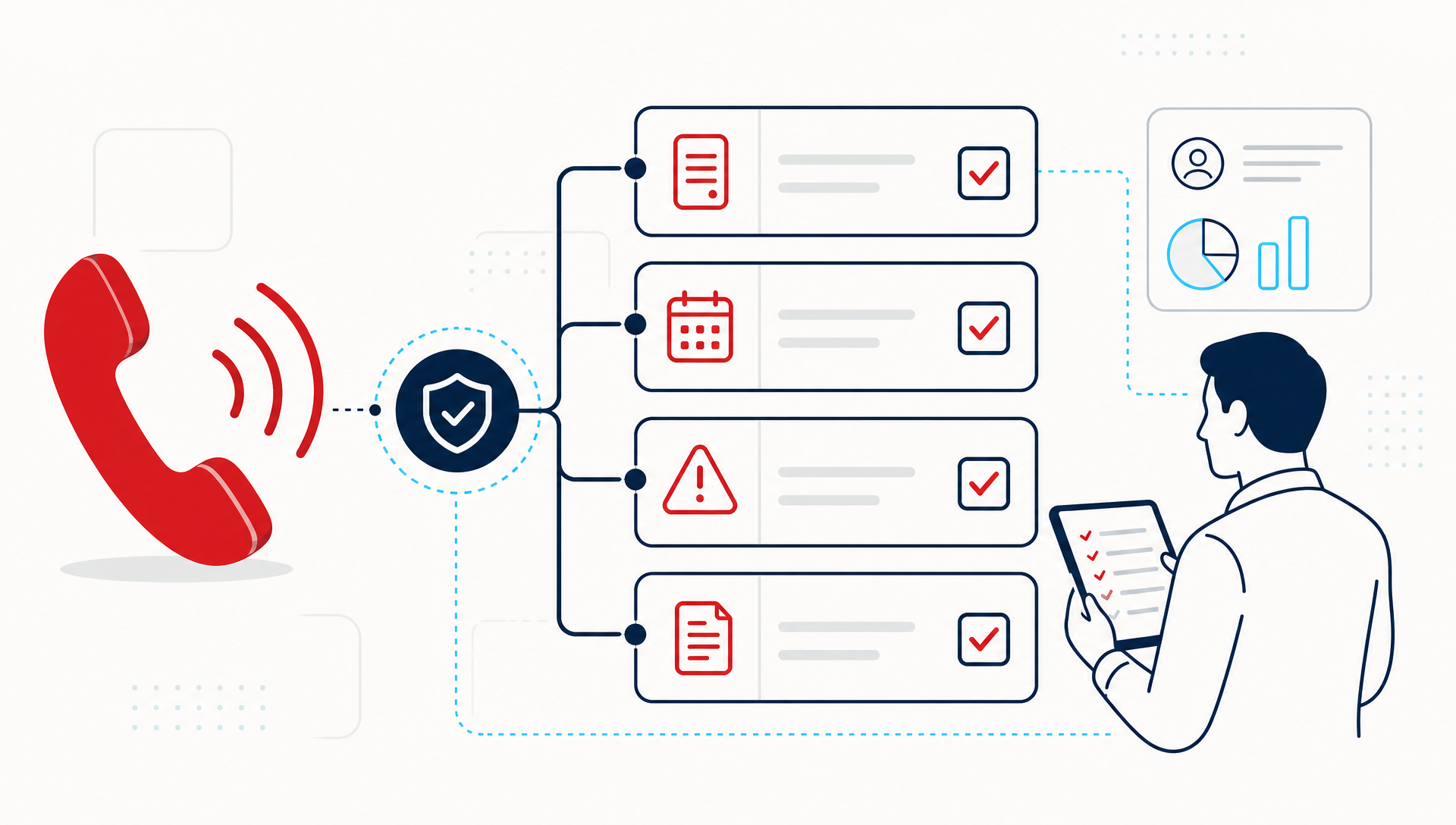
The figure in your phone system report counts everything. What gets analyzed is a smaller set. A recorded inbound or outbound call that was actually a conversation counts once. A call transferred between two of your own people is still one conversation, not two.
Several things do not count at all:
- Any call that was not recorded in the first place.
- Calls that ring out, and voicemails where no conversation happened.
- Internal extension-to-extension calls between your own staff.
For most businesses this lands meaningfully below the headline number. Two hundred calls a week is roughly 870 a month, and after the exclusions a typical operation is analyzing somewhere in the region of 600. Worth knowing before you price anything, and worth checking rather than guessing, which is what the coverage audit is for.
The two numbers that actually decide it
Whether this pays has very little to do with how many calls you take. It comes down to two things.
What one missed opportunity is worth to you. A booking, a job, a case, a patient, a repeat customer who quietly stopped calling. Take your average and be honest about the lifetime value rather than the first transaction.
What proportion of your calls carry real consequence. At a busy retail counter most calls are quick and low stakes. At a law firm's intake line nearly every call is consequential. Same technology, very different return.
Multiply those together and you get the shape of the answer. High volume with low value per call can be a weaker case than low volume with high value per call, which is the opposite of what the category's marketing implies.
How to run the math before you ask anyone for a number
You can do this on the back of an envelope, and you should do it before you take a sales call rather than after. Three steps.
One. Start from your recorded volume, not your call volume. At 200 calls a week that is roughly 870 a month, and after the exclusions above a typical operation lands near 600 conversations actually analyzed. Any quote worth comparing is built on that number.
Two. Take the annual cost of whatever you are quoted, including any one-time setup, and divide it by what one lost customer is worth to you over their lifetime.
Three. Read the answer as a target. It tells you how many recovered customers a year the thing has to produce to pay for itself. If that number is under one a month, this is worth a serious conversation. If it runs to several a month, either the tier is wrong for your volume or the product is wrong for your business.
Three things shift that calculation more than anything a vendor will tell you:
- Higher value per customer makes this easy. If a single job runs into the thousands, recovering one or two across a year is a low bar.
- Lower value per customer rests on consequence, not size. If your average job is small, the case depends on how many of your calls genuinely matter rather than on what any one of them is worth.
- Lifetime value is the honest input. Using the first invoice understates it, often badly, and it is the most common reason this calculation comes out looking worse than reality.
When is the answer genuinely no?
There are real cases where we would tell you to wait, and it is cheaper for everyone to find them now.
- Almost none of your calls are recorded. This is a prerequisite, not a preference. Fix coverage first and the rest of the conversation becomes worth having.
- Your phone is not really how customers reach you. If the majority of your business arrives by form, chat, or in person, you would be measuring a minor channel.
- Nobody has twenty minutes a week to act on it. Insight that nobody reads is a subscription, not an improvement. This is the most common reason these projects fail, at every size.
- You already know what is wrong. If your team is short-staffed and everybody knows it, spend the money on the staffing. Insight is for problems you cannot see, not the ones you are living with.
When low volume is the strongest case
The flip side is worth saying, because smaller operations tend to talk themselves out of the case where they have the most to gain.
In a large contact center, one badly handled call is a rounding error against the average. In a twelve person business taking 200 calls a week, one badly handled call in a month can be a measurable share of that month. The consequences are concentrated, which makes them easier to trace and easier to fix.
Small teams also have no QA function. Nobody is sampling calls, nobody is scoring anyone, and the owner hears about a problem when a customer is annoyed enough to mention it. That is a much wider blind spot than a large operation has, and it is the gap this closes.
What to have ready before you call anyone
Four things, and you can gather all of them yourself.
- Your recorded volume, not your call volume. This is the number that prices the product and it is usually a surprise.
- What one lost customer is worth. Over their lifetime with you, not on the first invoice.
- Your own break-even target. Recovered customers a year, worked out from the two numbers above.
- The name of whoever will read the output. If you cannot name them, deal with that before anything else.
Bring those four and the pricing conversation takes about fifteen minutes, because the only thing left to establish is which tier your volume falls into.
Every call is a customer experience, and a smaller business feels each one more, not less. The question was never whether you are big enough. It is whether the calls you are not hearing are costing you more than knowing about them would.
FAQ
Is there a minimum call volume for conversational insights?
There is no hard floor. The practical minimum is having enough recorded calls for a repeated problem to appear more than once, since a single example is an anecdote rather than a pattern. Most businesses with a genuine inbound line clear that easily.
What counts as a conversation analyzed?
A recorded inbound or outbound call that gets read, counted once even if it was transferred between your own people. Unrecorded calls, calls that ring out, voicemails with no conversation, and internal extension-to-extension calls do not count.
Are you priced per user or per call?
Per conversation analyzed, not per seat. Conversation analytics is usually sold per user per month, which prices the size of your team rather than the size of the problem, so a small office with a heavy inbound queue ends up paying less than a larger one whose phones barely ring. If you are comparing us against a per-seat quote, compare total monthly spend rather than the headline rate.
What happens if we go over our tier in a busy month?
Tiers are a monthly ceiling on conversations analyzed, and anything above it is billed as overage at a fixed per-conversation rate, counted month by month and billed quarterly. There is no separate threshold and no judgement call, so your worst case is arithmetic you can do yourself. If the overage says you have outgrown the tier, we will tell you.
Do seasonal businesses get penalized for quiet months?
Tiers are a monthly ceiling that resets each month, so a quiet month simply uses less of it. Pick the tier that covers your normal months rather than your peak and treat the busy months as overage, which is usually the cheaper shape.
Is this cheaper than hiring someone to review calls?
Considerably, but that is not really the comparison. Nobody reviews every call, so the realistic alternative is not a reviewer, it is sampling a handful of calls occasionally and hoping the ones that mattered were in the sample.
Will Maddox is the Digital Marketing Coordinator at TeleCloud, overseeing content, brand, and outbound strategy for the company. He writes about cloud communications, AI tools for business, and what SMBs and urgent care operators need to know to run better phone systems. Connect with Will on LinkedIn or email him directly to learn more.