
You can't analyze the calls you never recorded: audit your coverage
September 15th, 2026
5 min read
By Will Maddox
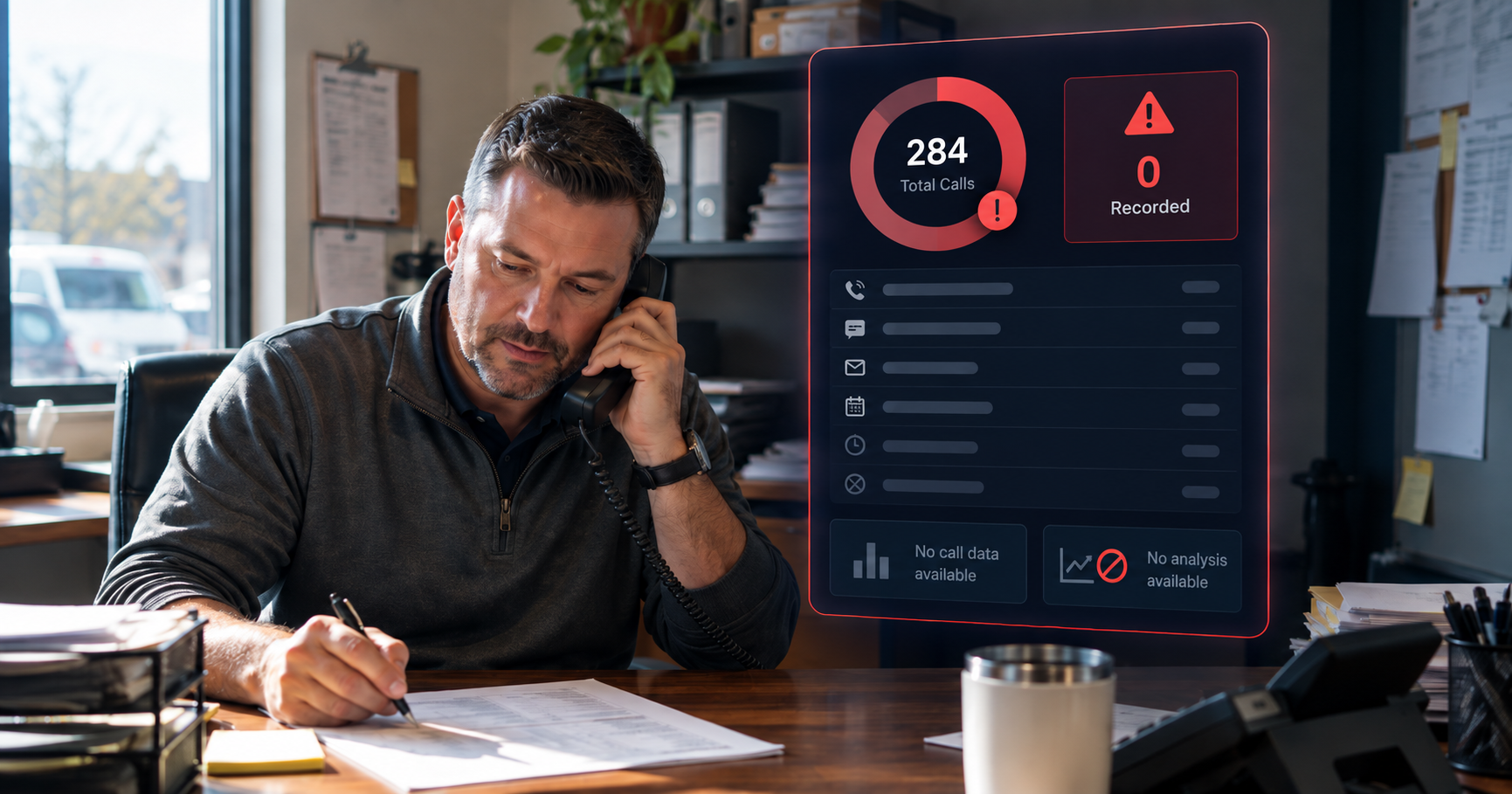
Conversational insights can only read the calls your system actually recorded, and most businesses have no idea what that number really is. Before you compare platforms or sit through a demo, it is worth twenty minutes finding out how much of your call volume is actually being captured.
This is the step that gets skipped. The conversation usually starts at the interesting end: what the AI can find, which calls it flags, what the dashboard looks like on a Monday morning. All of that is real. None of it works on a call that was never recorded in the first place.
If a third of your extensions are not being captured, you are not buying visibility into your business. You are buying visibility into two thirds of it, and you will not know which two thirds.
What does recording coverage actually mean?
Most people treat call recording as a yes or no question. It almost never is. Recording is a setting, and settings get applied unevenly over years of adding staff, changing plans, and moving people between roles.
Coverage is the honest version of the question: what percentage of the calls that matter to your business end up as a recording your system can actually read? That number is rarely 100%, and it is rarely what the owner assumes.
Why does partial recording happen to almost everyone?
Not because anyone made a bad decision. It is the ordinary result of a phone system that has been running for a few years.
- Recording is usually tied to a plan tier. On our own plans, call recording starts at the Pro tier. Anyone still sitting on a Basic seat is not being recorded, and that is easy to miss when the seats were assigned by budget rather than by who talks to customers.
- New extensions inherit nothing. Someone joins, an extension gets built quickly so they can start Monday, and the recording setting is not part of that checklist.
- Old exclusions never get revisited. A manager asked to be left off recording in 2021 for a reason that made sense then. Nobody has looked at that list since.
- The edges get missed. Mobile app calls, forwarded calls to a personal cell, after-hours overflow, and calls that roll to an answering service often travel a different path than the desk phones everyone was thinking about.
None of this is a failure of attention. It is just what happens when a setting is configured once and then the business keeps changing around it.
How do you audit your recording coverage in four steps?
You can do this yourself, in your own portal, without involving a vendor. It takes about twenty minutes.
1. Find out whether recording is set at the domain level or per user
These are two different switches and they behave differently. A domain-level setting applies to everyone by default, which is the cleaner starting point. A per-user setting means coverage is only as complete as the last person who remembered to turn it on. If you do not know which one you are on, that is the first thing to ask.
2. List every extension that is not being recorded, and ask why
Print the list. Go name by name. Some exclusions are correct and should stay, like a private line or an HR extension. What you are looking for is the front desk person hired in March, the second dispatcher, the salesperson who works from the mobile app. Those are the gaps that cost you something.
3. Check how long recordings are kept
Retention decides how far back any analysis can look. If your system keeps 30 days, you can see this month's patterns but you cannot compare this quarter to last, and you cannot go back and understand a customer who left in June. Retention is usually adjustable, and it is worth knowing your number before it matters.
4. Test the edges yourself
Place four calls and then go looking for the recordings: one to the main line during business hours, one after hours, one from the mobile app, and one that gets transferred between two people. This is the step that surprises people. Transferred calls in particular have a habit of ending up as two partial recordings or one, depending on how the system is configured.
What does each gap actually cost you?
This is where the audit stops being a technical exercise. Each gap removes a specific kind of answer from the table.
- An unrecorded new hire means you cannot tell whether your onboarding is working, which is exactly when you most want to know.
- Unrecorded after-hours calls mean the hours with the least supervision are also the hours with the least evidence.
- Unrecorded mobile calls usually means your most senior people, the ones handling the largest accounts, are the least visible.
- Short retention means you can spot a pattern but you cannot prove it started before you noticed it.
There is a quality dimension too. Coverage gets you the call, but a call captured through a bad connection or a poorly configured handset can still be hard to read. We wrote about that separately in why AI call insights miss half the conversation, and it is worth a look once your coverage is sorted.
Is 100% coverage the goal?
Not always, and we would rather say so plainly. Some extensions should not be recorded. A personal line, an HR conversation, a partner's direct dial. The useful target is not every extension in the building. It is every extension where a customer might be on the other end.
If you get there, you have something worth analyzing. If you are at half of that, the honest move is to fix the coverage first and look at insights platforms second, because otherwise you are paying to analyze a sample you did not choose on purpose.
What changes once the recordings are actually there?
Recording on its own does not solve anything. A complete archive that nobody listens to is just a bigger pile of files, which is the point we made in conversational insights versus call recordings. Most teams review a small fraction of their calls, and the ones they pick are rarely the ones that would have told them the most.
What complete coverage does is make the next step possible. TeleCloud Sentinel Conversational Insights reads every recorded call automatically and surfaces the patterns: the quote that never got followed up, the customer who called three times about the same thing, the location handling calls differently than the one across town. It can only do that for calls that exist.
So the order matters. Coverage first, then insight. Anyone who tells you otherwise is selling you a view of a sample.
FAQ
How do I find my current call recording coverage?
Start in your phone system's admin portal and check whether recording is enabled at the domain level or per user, then pull the list of users and compare it against the people who actually speak to customers. If you are a TeleCloud customer and cannot find it, ask us and we will pull the coverage numbers for your domain.
Do I need call recording to use conversational insights?
Yes. Conversational insights works from recordings and transcripts, so a call that was never captured cannot be analyzed later. This is the one genuine prerequisite, and it is why we recommend auditing coverage before comparing platforms.
Can I turn recording on for everyone at once?
Usually yes, if recording is available on your plan and set at the domain level. Where it is tied to individual seats, users on plan tiers without recording will need to be moved up before they can be captured. It is normally a plan change rather than a project.
Do we need to tell callers we are recording?
Consent rules vary by state, and some states require all parties on the call to consent rather than just one. Most businesses handle it with a short announcement at the start of the call. This is worth confirming with your own counsel, particularly if you take calls from customers in other states.
How long should we keep call recordings?
Long enough to compare one period to another, so at least a few months for most businesses. Regulated industries often have their own retention requirements that override general preference, so check those first.
What if we only record some of our team on purpose?
That is fine, as long as it is on purpose. The problem is not deliberate exclusions, it is the ones nobody decided on. Knowing exactly who is excluded and why is the outcome the audit is really after.
Will Maddox is the Digital Marketing Coordinator at TeleCloud, overseeing content, brand, and outbound strategy for the company. He writes about cloud communications, AI tools for business, and what SMBs and urgent care operators need to know to run better phone systems. Connect with Will on LinkedIn or email him directly to learn more.
Topics: