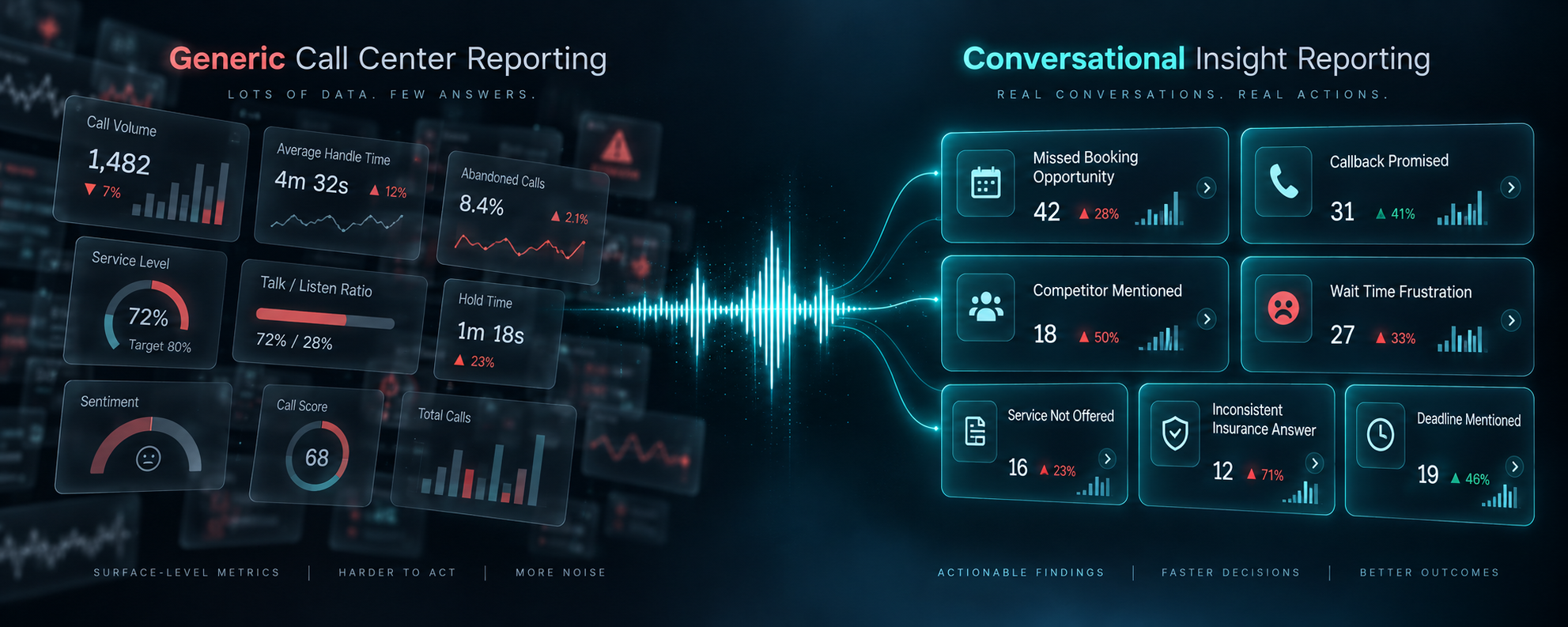

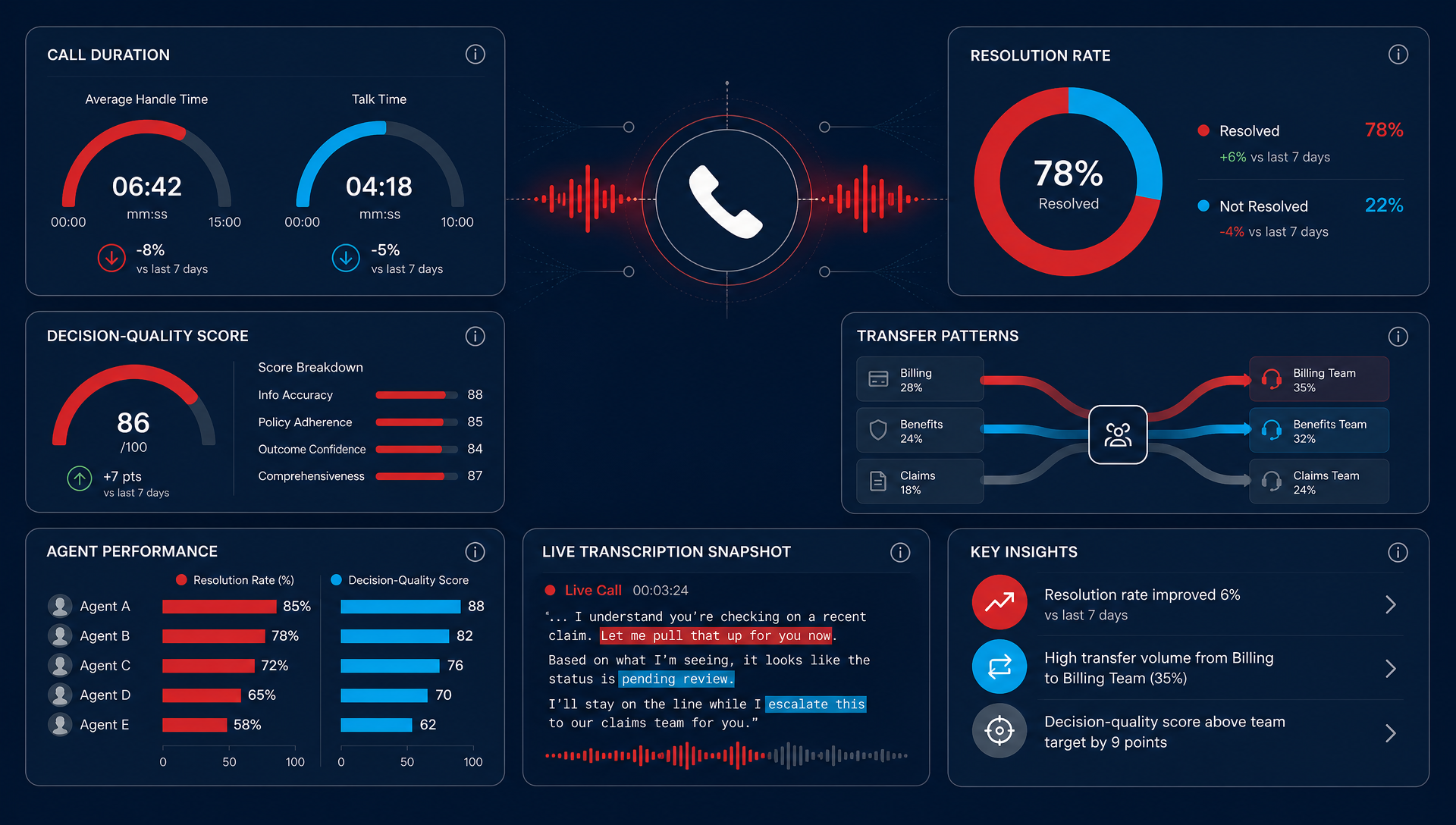
Surveys tell you how people felt after the fact. Call data tells you what actually happened on the call, which agents solved the issue, and where the process broke down.
If you're managing a contact center, that difference matters Monday morning, because coaching on the wrong signal burns time and misses the real fix. We see this a lot in call review work: the numbers that look clean on a dashboard often hide the calls that need attention most.
Engagement scores can still be useful, but they are a lagging read. They do not show decision quality, hold behavior, transfer patterns, or whether an agent resolved the issue on the first try. That is why call data is a better coaching tool than surveys alone.
Why surveys miss the real performance signal
A survey measures perception. A call measures behavior. Those are not the same thing, and in a busy contact center they can point in opposite directions.
An agent can sound upbeat, score well on a pulse survey, and still miss the steps that matter: failing to confirm details, escalating too early, or putting the caller on hold too long. Another agent may have a rough week on sentiment but still solve more issues, move calls faster, and keep customers from bouncing back into the queue. Performance lives in the call, not the vibe check.
That is why sentiment scores alone do not tell you who is helping the customer move forward. They tell you how the interaction felt in the moment. They do not tell you whether the customer got what they needed.
What call data shows that a survey cannot
Call data gives you the parts of the interaction that a questionnaire never sees:
- Decision quality, whether the agent made the right call with the information available.
- Call efficiency, how much time was spent searching, repeating, or transferring.
- Resolution pattern, whether the issue was solved, escalated, or came back later.
- Customer friction, where the conversation stalled, confused the caller, or created a second touch.
- Behavioral consistency, whether the same agent follows the right process every time.
If you want a simple test, ask this: would you rather coach an agent on how they felt about a shift, or on the 12 calls where they missed the right next step? One tells you morale, the other tells you where revenue and retention are leaking.
What this looks like in a real contact center
Picture a 20-rep team where surveys say morale is steady. The queue still gets backed up, first-call resolution is flat, and two supervisors keep escalating the same types of calls. The survey does not explain why.
In our deployments, that is usually where the pattern shows up first, in the calls from the front desk, the scheduler, or the intake rep who keeps missing one step in the handoff. The team may look fine on paper, but the caller is still repeating the story, waiting on hold, or getting sent back to the same menu.
Call data usually does. You may find that one rep is great at tone but asks too few clarifying questions. Another rep closes fast but sends callers back into the same menu because they do not confirm the issue. A third rep handles complex calls well but transfers too often when the script gets awkward. Those are coaching problems, not attitude problems.
That is where structured call analysis beats anecdotal feedback. Instead of asking, "How did last week feel?" you can ask, "Which behaviors are driving repeat calls, unnecessary transfers, or long handle times?" That is a much better question for the front line supervisor.
How Conversational AI Insights changes the coaching conversation
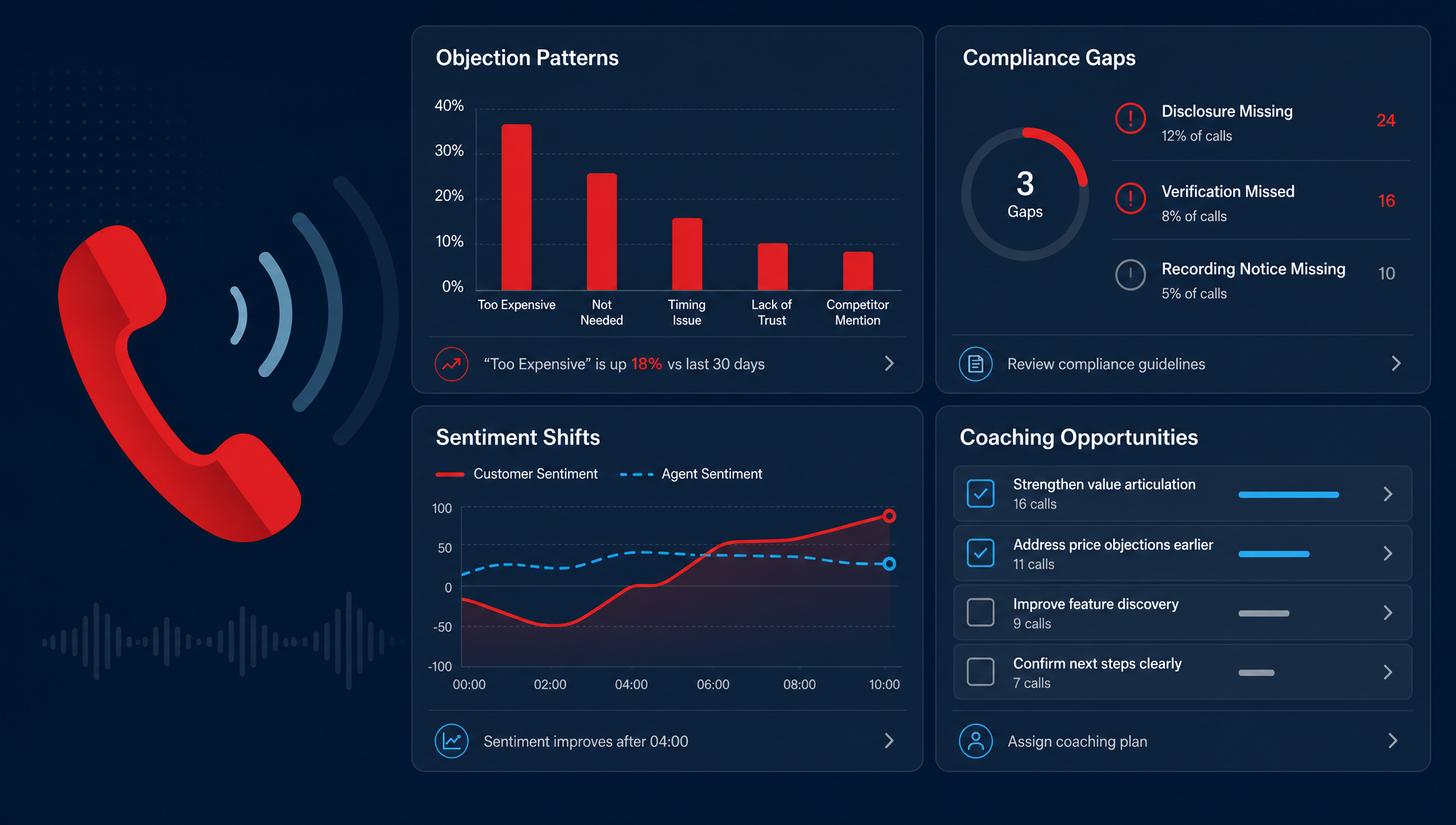
This is the kind of problem Conversational AI Insights is built for. It reads recorded calls, turns them into structured signals, and surfaces patterns across sentiment, intent, talk ratio, transfer behavior, and resolution trends. In our deployments, that gives managers a way to coach from actual call behavior instead of guessing from a scorecard.
That matters because the call itself is the evidence. If a rep sounds engaged but keeps missing the same step, AI Insights shows the pattern. If a location is getting more escalations than the others, you can see it before the CX numbers slide.
For teams still relying on recordings only, this is the difference between listening to a few random calls and spotting the same friction across hundreds of calls. If you want the foundation piece behind that approach, start with what call recording can and cannot tell you: AI starts with call recording.
TeleCloud's Conversational AI Insights reads 100% of recorded calls and turns them into coaching signals, so supervisors are not left guessing from a survey score or a handful of cherry-picked calls. That is the operational value, better visibility into how calls are handled, not just how people felt afterward.
What to coach first when the data is ugly
When call data starts pointing in the same direction, do not try to fix everything at once. Start with the highest-friction pattern.
A practical order looks like this:
- Repeat the top escalation reason, then coach the exact step where the call goes off track.
- Look for long holds and transfers, then check whether the agent is searching for answers or avoiding ownership.
- Compare high and low performers on the same call type, then isolate the behavior that separates them.
- Check resolution on the second contact, not just the first answer.
That gives a supervisor something concrete to work on in the next one-to-one. It also helps you avoid the trap of praising the "engaged" rep who is actually creating more work downstream.
When surveys still help
Surveys are not useless. They are just incomplete.
Use them to understand morale, manager trust, and whether a team is burning out. Use call data to understand whether the work is getting done well. The right mix is human feedback plus behavioral evidence, not one replacing the other.
That is especially true in multi-location environments, where one site can look fine on a pulse survey while another site quietly racks up transfers, repeats, and avoidable escalations. You need the call trace to see the gap.
If you are comparing how this fits with a broader phone stack, the same call data can live inside a TeleCloud Voice environment and feed the same review workflow. That is the part that matters for the operator, the phone system keeps the calls flowing, and AI Insights shows where the calls are going sideways.
What to put in place before your next coaching cycle
If you are the operations leader or contact center manager, start small this week:
- Pick one call type, like cancellations, billing, or scheduling.
- Review the calls with the highest friction, not the nicest ones.
- Track one behavior, such as confirmation questions or transfer rate.
- Compare two reps who handle the same call type differently.
- Use those patterns to build one coaching note, not a generic score.
That is usually enough to show whether your survey data is telling the truth or just making the dashboard look calm. Once you can see the behavior, you can coach the behavior.
Stop losing the signal inside survey scores
The point is not to throw out surveys. It is to stop treating them like the whole story when the whole story is sitting in the calls themselves. If you want to coach better, the best starting point is the interaction that already happened, not the score someone filled out later.
If you want to see how that works in your own call flow, talk to us about Conversational AI Insights and the kind of patterns it can surface for your team.
FAQ
Can call data replace engagement surveys entirely?
Not completely. Surveys still help you understand morale, trust, and how the team feels about the work.
Call data is better for coaching performance because it shows what happened on real customer calls. Most teams need both, but they should not confuse them.
What call metrics matter most for coaching?
Start with resolution rate, transfer rate, hold time, and repeat-contact patterns. Those four usually tell you more about day-to-day execution than a sentiment score does.
If you only track one thing, track whether the caller got to the right outcome with the fewest handoffs.
How does AI help with call review?
AI can review more calls than a supervisor can listen to manually. That makes it easier to spot repeated behaviors, not just one-off problems.
With Conversational AI Insights, the goal is not to replace the coach. It is to point the coach at the calls that actually matter.
Is sentiment ever useful for performance management?
Yes, but only as one signal. Sentiment can tell you where calls felt tense or where customers were frustrated.
It should not be the only measure of agent performance. A calm voice does not always mean a good outcome, and a rough call does not always mean a bad one.
How quickly can a team use call data for coaching?
Most teams can start with one call type and one metric in a single review cycle. The hard part is not collecting the data, it is deciding what behavior to coach first.
Once the team agrees on that, the supervisor can move faster and coach with more confidence.
Will Maddox is the Digital Marketing Coordinator at TeleCloud, overseeing content, brand, and outbound strategy for the company. He writes about cloud communications, AI tools for business, and what SMBs and urgent care operators need to know to run better phone systems. Connect with Will on LinkedIn or email him directly to learn more.
Topics: